New submarine cable break: East Africa degrades for 11 hours
Simultaneous breaks on the EASSy and SEACOM cables caused internet outages affecting Kenya, Tanzania, Mozambique and Zambia. The incident reignites the debate on the resilience of Africa's intercontinental connections.
Severity
4Affected country
KESector
TelecomsPublished
2 June 2026
Our score measures operational relevance to Africa — not the global virality of the story.
Contents · 5
The incident
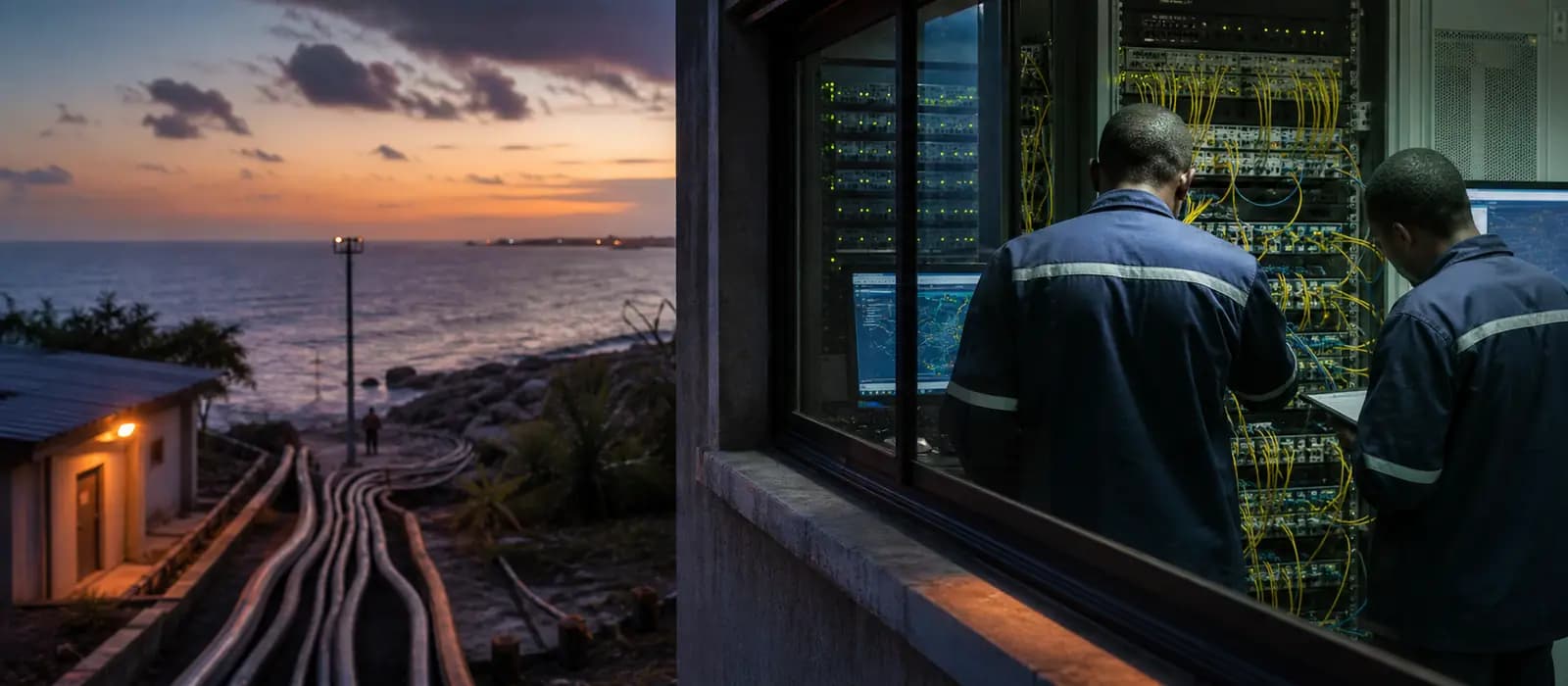
On June 1, 2026 at 03:14 UTC, two major submarine cables serving eastern and southern Africa suffered breaks within 40 minutes of each other. EASSy (Eastern Africa Submarine Cable System) was affected first, then SEACOM. The temporal coincidence suggests a common cause — likely a submarine sediment movement in the Mozambique Channel, already identified as a risk zone.
The degradation window lasted 11 hours, from 03:14 to 14:22 UTC. During this period, intercontinental transit capacity to Europe and Asia was reduced by 60 to 75% depending on the country.
Countries and services affected
Kenya: Safaricom reported disruptions to its mobile data services and M-Pesa, used daily by more than 30 million people. M-Pesa transactions fell 40% for 4 hours before traffic was rerouted via TEAMS.
Tanzania: TTCL and Airtel Tanzania recorded latencies multiplied by 8 towards Europe.
Mozambique: TDM (Telecomunicações de Moçambique) had insufficient rerouting capacity; government cloud services remained inaccessible for 9 hours.
Zambia: Zamtel reported a complete interruption of its international links for 2 hours.
The structural problem
East Africa has an insufficient number of geographically diversified submarine cables. Most cables serving the African east coast (EASSy, SEACOM, TEAMS, EASSY) share common route segments and nearby landing points. A break in the Mozambican zone affects multiple cables simultaneously.
By comparison, Western Europe has more than 30 distinct submarine cable routes. East Africa, with 7 active cables, is structurally under-provisioned.
The 2Africa cable: a partial solution
The 2Africa cable, whose deployment continues in 2026, is set to add significant capacity and alternative routes. However, 2Africa largely follows the same coastal route as existing cables on several segments. Geographic diversity remains insufficient.
What governments and operators must anticipate
— Strengthen cross-border terrestrial interconnection agreements (terrestrial fibre) for emergency rerouting. — Require operators to publicly document their rerouting capabilities. — Invest in robust national IXPs (internet exchange points) to maintain local traffic during international outages. — Consider satellite connections (Starlink, OneWeb) as backup capacity for critical government services.
— ◆ —